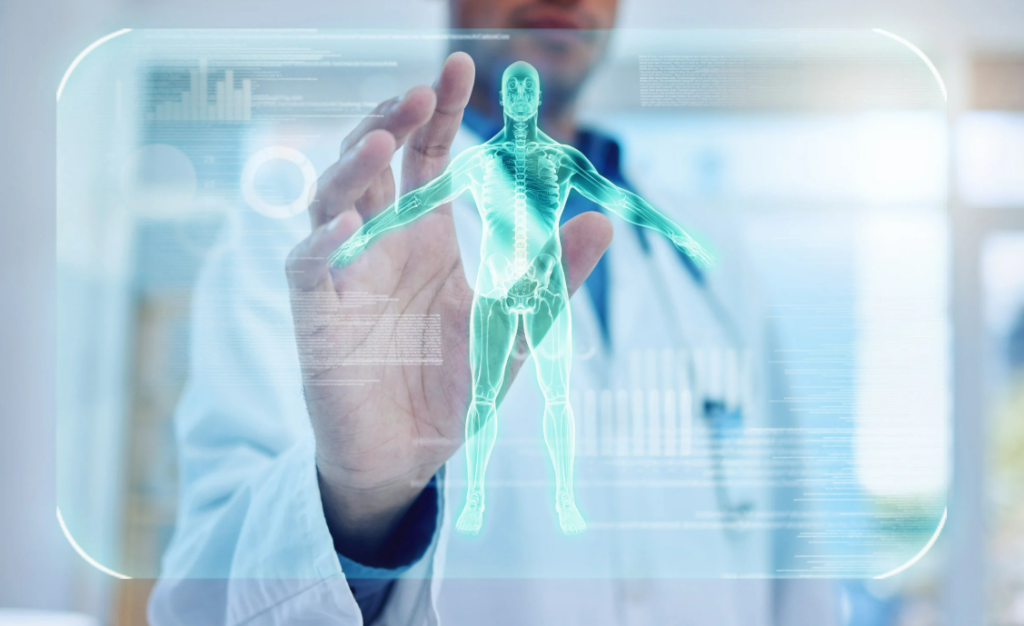
Artificial intelligence is rapidly transforming healthcare from a future promise into a present reality. No longer limited to research settings, AI tools are being deployed in hospitals and clinics across continents, offering earlier diagnoses, streamlined workflows, and new avenues for treatment. These advances highlight both the vast potential of AI and the pressing need to ensure its safe, equitable, and sustainable integration into health systems worldwide.
Uses of AI in Healthcare
Diagnostic Imaging
Recent developments have positioned diagnostic imaging at the forefront of medical advancements. Deep learning models now demonstrate remarkable proficiency in recognising complex patterns within scans, photographs, and endoscopic videos, achieving accuracy levels that are comparable to or supportive of expert clinicians.
Cancer detection
Artificial intelligence improves early cancer detection by employing advanced algorithms and diverse data sources to identify malignant changes with greater accuracy and non-invasiveness compared to traditional methods. AI applications include biosensors that analyse volatile organic compounds in breath, spectroscopic techniques such as NMR, MS, and IR, and the examination of circulating tumour DNA and circulating tumour cells from liquid biopsies. These methods enable rapid and precise point-of-care diagnostics, enhance the recognition of subtle biochemical and imaging patterns, and support earlier detection and differentiation of tumour subtypes, thereby potentially improving patient outcomes.
Skin cancer is a domain of rapid progress. In the United States, the Food and Drug Administration has cleared several AI tools for dermatological assessment. In low-resource settings, smartphone-based image recognition is being tested as a means of extending dermatological expertise to rural populations.
Radiology
In multiple areas, including breast and chest imaging, cardiovascular and abdominal radiology, etc., AI improves diagnostic accuracy, speed, and consistency. These systems support early disease detection, tumour grading, and risk assessment while helping radiologists make faster and more informed decisions. AI also contributes to workflow efficiency, reduces radiation exposure, and assists in personalised treatment planning by integrating imaging with molecular and genetic information. By enhancing image quality, streamlining complex analyses, and supporting precise interventions, AI is helping radiologists provide more accurate diagnoses and better outcomes for patients.
AI is also being applied to the less visible but equally vital dimensions of healthcare delivery.
Clinical documentation
Ambient AI scribes, also known as digital scribes, are designed to listen to patient-clinician interactions and generate clinical notes for review, revision, and approval, thereby streamlining the documentation process. By automating routine tasks, AI scribes have been shown to improve workflow efficiency, reduce after-hours electronic health record work, and allow clinicians to focus more fully on patient interaction. Early studies suggest that these technologies may lower cognitive load and support clinician well-being, while also enhancing documentation quality and consistency. AI scribes can integrate with electronic health record systems, helping to standardise notes, reduce errors, and ensure critical information is captured accurately. Additionally, they offer potential benefits for personalised care by quickly summarising patient encounters, highlighting relevant medical history, and supporting timely follow-up actions.
Drug discovery
 Drug development remains a costly and time-intensive process, often requiring over 15 years and more than $2 billion to bring a new treatment to market. Compounded by Eroom’s Law, which highlights the doubling of drug development costs approximately every nine years, these financial and temporal constraints risk creating a supply-demand imbalance, potentially leaving patients underserved and companies struggling with profitability and sustainability
Despite these investments, the success rate of a drug candidate remains low, with a recent study revealing an average likelihood of first approval rate of 14.3%, with a range from 8% to 23%.
A 2019 report highlights that one company projected AI-driven drug discovery could reduce costs by $300 million to $400 million per drug, thanks to enhanced R&D productivity. This aligns with a 2023 report by the Boston Consulting group that AI could reduce the time and cost of the drug discovery to preclinical stages by at least 25 to 50 per cent.
While AI cannot directly create drugs, it excels at identifying promising molecule combinations for specific diseases. By analysing vast amounts of biomedical data, AI can also find new uses for existing drugs, accelerating drug discovery and lowering costs. This process, known as drug repurposing, allows approved medications to skip early trials and move straight to Phase II, saving over $8.4 million in the process.
Economic considerations
Across nineteen studies covering oncology, cardiology, ophthalmology, and infectious diseases, AI interventions were shown to enhance diagnostic accuracy, increase quality-adjusted life years, and lower healthcare costs, primarily by reducing unnecessary procedures and improving resource utilisation. Multiple interventions reported incremental cost-effectiveness ratios that were substantially below established thresholds.
Low- and middle-income countries face particular challenges. While AI could extend scarce expertise, upfront costs and infrastructure demands risk widening rather than narrowing global inequalities. International collaborations and open-source initiatives may help bridge this divide, but sustained investment is required.
Risks and Ethical Concerns

Patient safety and clinical reliability
One concern is over-reliance on automated systems. If clinicians defer too much to AI, diagnostic errors may go unnoticed. Studies of colonoscopy AI show benefits, but also illustrate how performance gains may diminish outside controlled trial settings. Implementation quality and human vigilance remain crucial.
Bias and fairness
AI reflects the data it is trained on. If datasets underrepresent certain populations, tools may perform poorly for them. This has been demonstrated in dermatology, where many AI models trained on lighter skin types show reduced accuracy for darker skin. Such disparities risk deepening health inequities.
Data protection and trust
Healthcare data are highly sensitive. The World Health Organization’s guidance on artificial intelligence in health, stresses principles of autonomy, transparency and equity. Its 2025 report on large multimodal models highlights new risks when systems can analyse text, images and other media together, calling for rigorous governance and safeguards against misuse.
Case studies: AI in action around the world
India: tackling diabetic blindness
India has a high burden of diabetes, putting millions at risk of vision loss from diabetic retinopathy. Screening is particularly challenging in rural areas with few ophthalmologists. To address this, Aravind Eye Hospitals deployed the ARDA AI system to analyse retinal images captured by technicians using fundus cameras. To date, ARDA has screened over 600,000 patients across Tamil Nadu, referring an estimated 22,200 individuals with severe or proliferative DR. The system achieved 97.0% sensitivity and 96.4% specificity for severe DR and 95.9% sensitivity and 94.9% specificity for sight-threatening DR, enabling targeted referrals and expanding access to preventive care.
United States: AI in stroke care
In many parts of the United States, AI is being used to speed up stroke diagnosis. Time is critical when a patient arrives at the hospital with suspected stroke, since clot-busting drugs and surgical interventions are most effective within narrow windows. Several FDA-cleared AI platforms can automatically analyse brain CT scans and alert radiologists and stroke teams to suspected large vessel occlusions. Real-world studies suggest that these tools can shave valuable minutes off diagnosis-to-treatment time, potentially improving outcomes. Their adoption illustrates how AI is best positioned not as a replacement for clinicians but as a way of accelerating critical pathways.
Hong Kong: AI Enhances Endoscopy Training and Cancer Detection
CU Medicine has developed AI-assisted systems to improve gastrointestinal endoscopy, particularly for junior clinicians. A study of 22 endoscopists-in-training performing 766 colonoscopies showed that AI guidance increased overall adenoma detection rates from 44.5% to 57.5%, with small adenoma detection improving from 25% to 40.4%. The team also created AI-Endo, an AI surgical platform trained on over 2 million frames of endoscopic submucosal dissection (ESD) procedures. AI-Endo provides real-time guidance during ESD, allowing trainees to perform complex procedures safely and reducing the training time required for competency. These innovations enhance early cancer detection and standardise endoscopy training across skill levels.
Conclusion
The global integration of artificial intelligence into healthcare reflects a trajectory of steady progress rather than sudden revolution. While the technology offers significant benefits such as faster diagnoses and greater efficiency, its adoption must be guided by rigorous oversight, ethical safeguards, and equitable access. The risks of bias and privacy breaches underscore the importance of transparency and international collaboration. Ultimately, the most effective AI in healthcare may be that which works quietly in the background, enhancing safety, reducing burdens, and allowing clinicians to focus on patient care. If directed by evidence and trust, AI could become a cornerstone of modern medicine.
References
- Adel El Arab, R., & Moosa, A. (2025). Systematic review of cost effectiveness and budget impact of artificial intelligence in healthcare. Npj Digital Medicine, 8(1). https://doi.org/10.1038/s41746-025-01722-y
- Bhandari, A. (2024). Revolutionizing Radiology With Artificial Intelligence. Cureus, 16(10). https://doi.org/10.7759/cureus.72646
- Boston Consulting Group. (2023). Unlocking the Potential of AI in Drug Discovery: Current status, barriers and future opportunities.
- Brant, A., Singh, P., Yin, X., Yang, L., Nayar, J., Jeji, D., Matias, Y., Corrado, G. S., Webster, D. R., Virmani, S., Meenu, A., Kannan, N. B., Krause, J., Thng, F., Peng, L., Liu, Y., Widner, K., & Ramasamy, K. (2025). Performance of a Deep Learning Diabetic Retinopathy Algorithm in India. JAMA Network Open, 8(3), e250984–e250984. https://doi.org/10.1001/jamanetworkopen.2025.0984
- Chen, X., Wang, X., Zhang, K., Fung, K.-M., Thai, T. C., Moore, K., Mannel, R. S., Liu, H., Zheng, B., & Qiu, Y. (2022). Recent advances and clinical applications of deep learning in medical image analysis. Medical Image Analysis, 79, 102444. https://doi.org/10.1016/j.media.2022.102444
- Mikulic, M. (2023). AI usage in drug discovery: time and cost savings worldwide 2023 | Statista. Statista. https://www.statista.com/statistics/1428349/ai-usage-in-drug-discovery-time-and-cost-savings-worldwide/
- Paul, D., Sanap, G., Shenoy, S., Kalyane, D., Kalia, K., & Tekade, R. K. (2020). Artificial Intelligence in Drug Discovery and Development. Drug Discovery Today, 26(1), 80–93. PubMed Central. https://doi.org/10.1016/j.drudis.2020.10.010
- The Chinese University of Hong Kong. (2023, December 26). CU Medicine proves AI-assisted colonoscopy increases adenoma detection rate by 40%, and trains a new AI platform to assist early-stage gastrointestinal cancer treatment.
- Tiwari, A., Mishra, S., & Kuo, T.-R. (2025). Current AI technologies in cancer diagnostics and treatment. Molecular Cancer, 24(1). https://doi.org/10.1186/s12943-025-02369-9
- U.S. Government Accountability Office, & National Academy of Medicine. (2019). Artificial Intelligence in Health Care: Benefits and Challenges of Machine Learning in Drug Development.
We are Kainovation Technologies, leading the way in AI, ML, and Data Analytics. Our innovative solutions transform industries and enhance business operations. Contact us for all your AI needs.